Monday, April 22, 2013

Smithsonian National Museum of Natural History


The museum of Natural History located in the National Mall complex is one of the most visited museums within the complex, apart from the Smithsonian National Air and Space Museum. National Mall is a government held open space in Washington D.C. that houses several Smithsonian Museums, governmental buildings, and monuments of historical relevance for the United States. Museum of Natural History is part of the Smithsonian Research Complex. With the Smithsonian’s reputation of being the world's largest museum and research complex (consists of 19 museums and galleries, the National Zoological Park and nine research facilities) and the Museum of Natural Histories being 100 years old, I approached the place with an expectation of being awed and impressed.
It did awe me. The Hall of Dinosaurs had several foot tall dinosaur skeletons and ancient birds, including a life-size model of the Quetzalcoatlus northropi, which lived 70 million years ago, having a wingspan of 40-foot, and reputed to be the largest flying animal ever. Also residing above this hall is the jaw of an ancient shark, which lived in the oceans 5 million years ago. The very human-like faces in the Hall of Human Origins were eye-captivating. The faces had watery, real-like eyes on display cases dating back to thousands of years and were from across the globe.  Among these impressive displays was the Hope Diamond, the 23.1-carat ruby, one of the largest and finest rubies in the world in the Hall of Geology, Gems, and Minerals. Looking at all this amazing stuff, I thought I had missed the museum and had somehow mistakenly wandered into the sets of Jurassic Park or Ice Age.
What had happened to the museum? Where is the stuff, the Smithsonian boasts of? Where has their research on Human Evolution led them to? I closely read the reading material kept along the displays to find some sort of explanation to the dinosaur skeleton or the real-like human faces that were dated back to several thousand years and found none. The information available along with the displays were more focused on the description on the specimen, the sort that can be found in Wikipedia and less on how such a specimen was found or discussions that lead into serious topics. Later on while talking to others who had been to the museum, I found out that there was only a small bone in the rib-cage of one of the dinosaurs which was real and the rest of its body was constructed on assumptions. The same was the story for human-like faces. It is understandable to have reconstructions, but certainly not to way-led on-lookers. If most of what is displayed is reconstruction, it should be stated somewhere for people who might be interested in knowing about it. Their commitment to provide a wholesome entertainment doesn’t stop within their halls, but extends outside their building. Several display signs were erected around the Natural Museum and one of the recurring pictures was the following one:
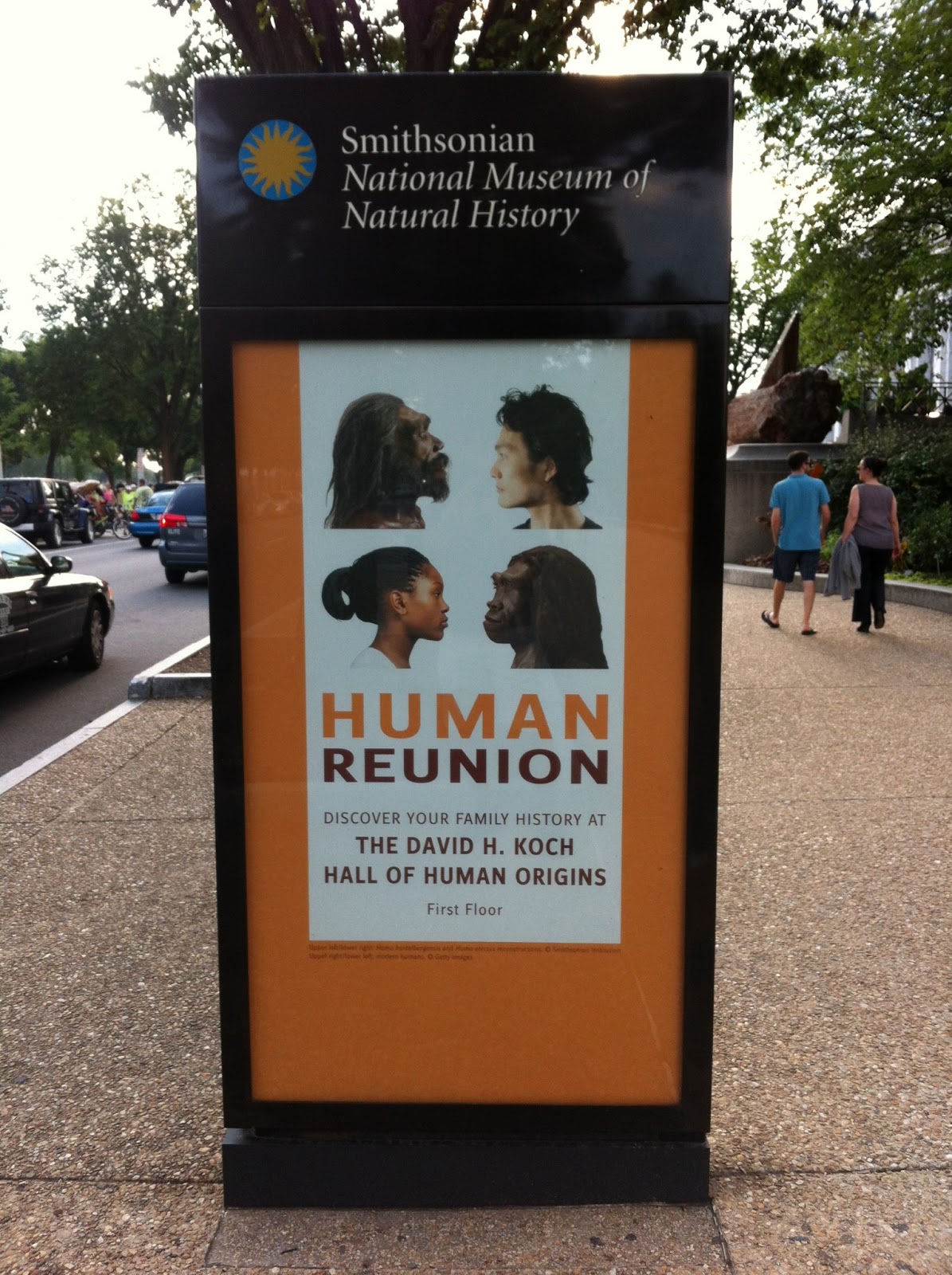
Every single display sign that advertised for the Hall of Human Origins displayed the above picture, showing a man of Asian origin and an women of African origin with his/her ‘ancestor’. As of 2008 (http://en.wikipedia.org/wiki/Race_and_ethnicity_in_the_United_States#Asian_Americans) only 4.4% of the U.S. population consists of Asian American and 12.4% of the whole population include Black Americans, while White Americans make-up the majority of the population at 80%.  Depicting a black American is quite understandable as they make up the second largest group, that is, if people of America are to be divided according to their racial make-up, but why people of Asian origin?

 According, to the museums official website, “the Museum’s temporary and permanent exhibitions serve to educate, enlighten and entertain millions of visitors each year”. Well, it certainly provides good entertainment to the visitors. However, it confounds the visitors more than enlighten them.

Monday, April 15, 2013

Donnie Darko


Donnie Darko with its compelling storyline gives raise to different interpretations, every time I watch it. The movie is tagged as “drama, mystery, and science-fiction” by IMDB. How well does the movie fulfill these genres?
The first time I watched the movie, I only appreciated the science-fiction side of the movie. I saw it as a movie exploring the theme of parallel universes and time travel. The movie was portraying the events that occurred in two different universes. There are multiple universes where the same incidents are happening at different times, that is, if these incidents from different universes are to be mapped on a single time scale. The creation of a worm hole connecting two universes, sends across Frank and an engine from a plane that crashes from one universe to the other, effecting changes in the other universe. This creation of worm hole repeats itself endlessly and the character Frank in the form of bunny rabbit, who travels to another universe through a worm hole, affects the incidents in the other universe by manipulating Donnie Darko to be inside his room. The official interpretation of the how the concept of time travel is dealt in the movie is different and is based on extra material outside of the movie and is beyond the scope of this review.  Later on, when I watched the movie for a second time, I felt that the concept of time travel was just a theme used to explore the philosophical concept of the existences of multiple realities.
There are multiple realities existing in the universe. The existences of these realities are a result of exercising our freewill. We have a choice to act in a certain way and powered by this choice we can change the course of things that happen in this world. Donnie has the choice to walk out of his room before the plane crashes and stay alive to kill Frank, see his first girlfriend die, burn the house of John Cunningham (the police finds paedo-pornography in his house when the house burns and they arrest John) or die. His death before these incidents take place would would mean that he would not kill Frank, his girlfriend may not die (she dies because she accompanies him to Roberta Sparrow’s house), and John Cunningham will not be arrested. Frank is nothing but an instrument in helping Donnie to exercise his freewill.  Does the movie have only philosophical underpinnings? If so, then it could have explored the concept much more deeply. For instance, it only looks at the freewill exercised by Donnie. Though Frank is instrumental in convincing Donnie to choose, Frank never chooses. It looks more like he is ‘destined’ to do it. As I watched the movie again, I felt the movie was not looking at the abstract philosophical concept of reality and the power to change reality through freewill, but at much more concrete issues.
The movie was dealing with the anxieties of a teenager who is feeling very lonely and afraid of accepting it. He is misunderstood by his family and some of his teachers. His ideas are radical and finds himself very removed from the society. He is further disturbed when Roberta Sparrow, a senile woman, whispers in his ears that every creature on this earth dies alone. The fact that one must die alone haunts him more than the fact that he feels alone in the world. In the end of the movie, he overcomes his fear to be alone and bravely meets death. His feeling of loneliness is bought out very beautifully in the song “Mad World”. I interpret the song the following way. Although there are familiar faces (family) around him, he can only see them racing through their lives and in the process making themselves miserable. He goes to his school with expectations of meeting new friends and learning new things in life and is let down badly. After going through the trauma of trying to be not alone he attains the maturity to be contended with death. For the lines from the song are ‘and I find it kind of funny, I find it kind of sad. These dreams in which I'm dying, are the best I’ve ever had’.
The movie at its face value appears to be a science fiction as it explicitly talks about the concept of time travel. Looking at the movie closely could make one think that it explores the abstract concept of reality and the manipulation of reality by using freewill. If so, then it had done it very simply. If it is viewed as a movie dealing with the anxieties of a teenager, then it had done well in exploring that topic. Therefore, I would say that the movie fits well into the categories of 'drama' and 'science fiction'. If we take the abstract philosophical concept of reality to fit the category of ‘mystery’, then it has not justifiably explored it.

Monday, April 8, 2013

Temple Run 2


Temple Run 2 reached a 50 million downloads within the first two weeks of its release in all three platforms, namely, iOS, Google Play, and Amazon Kindle. It has been in the app store since mid-January and continues to be popular among arcade game enthusiasts. Its predecessor, ‘Temple Run’ which had already been downloaded 170 million times before the release of Temple Run 2 had set an expectation that Temple Run 2 had to meet.
The game rules are simple and is same across both Temple Run and Temple Run 2. One has to keep running and stay out of reach of chaser(s) and at the same time avoid falling down bridges, cliffs, hitting on walls, and other obstacles. The game ends once we fail to avoid these obstacles.
The controls in Temple Run and Temple Run 2 are simple to master. We tilt our device to collect coins and avoid gaps in the paths and swipe left or right to turn corners. With several similarities between the two games, Imangi Studios sets Temple Run 2 apart with its graphically more elaborate environment. The boring straight paths of Temple Run gave a feeling of playing an MS DOS game, while the twisted and scenic mountain paths of Temple Run 2 make the environment more realistic. Sliding down ropes, crossing streams, navigating uneven surfaces, and wheeling on a cart under a mine shaft adds to the realistic feel the game gives to the user. One could safely say that Temple Run 2 has certainly met the expectations of the market for a free app.
Since, the app is free, it lures people into downloading the game and if one would like to finish the game faster, then one should purchase in-game coins and life savers by paying money. These in-game coins could also be collected while playing the game, but it takes longer to finish the objectives by solely depending on the coins collected while playing the game. Using the in-game coins, we could buy head starts and characters available from within the game. The four characters available in Temple Run 2 caught my attention.
The Character ‘Guy Dangerous’ is the starting character and comes for free. He is a ‘light skin’ toned ‘guy’. The next character is ‘Scarlett Fox’. She is a ‘light skin’ toned ‘female’ and can be unlocked for 5000 coins. The third character is ‘Barry Bones’. ‘He’ has a ‘dark skin’ tone and can be purchased for 15,000 coins. The fourth character is ‘Karma Lee’. ‘She’ has ‘slanting eyes’ and can be purchased for 25,000 coins. Along with three other characters all these four characters can also be found in the first version of the game. The racial and the gender differentiation is not very apparent in the earlier version as Scarlet Fox and Barry bones cost the same (the light skin toned female and the dark skin toned male), and the price for Karma Lee and the three additional characters were the same. Can pricing a female over male and non white skinned characters over the other two in Temple Run 2 be a mere coincidence?

If you are looking for a game that demands less thinking and at the same time entertaining then Temple Run 2 is worth your notice. The game also goes a step further to ‘quell’ any gender and racial accusations one might have against it.

Monday, March 18, 2013

Restaurant that stands apart.

Krishna's South Indian Veg Restaurant in Zurich offers a welcome respite for an Indian foodie who is looking for a different taste and food from India that the usual Indian dishes found in Indian restaurants across Switzerland. We find the same dishes duplicated in the menu cards of most of the Indian restaurants in Switzerland. Most notably these dishes are from a particular region in India. The image below would give an idea of the variety in food that can be found in India.


The dishes mentioned above in the map is but the tip of an iceberg of the food variety that can be found in India. That being the case, it is hard to understand the tendencies of these restaurants to stick to particular dishes. Even the restaurants like the Kerala food restaurant in Zurich and the Kanchi restaurant in Luzern that pose to represent the food culture of a particular region in India offers more items from other regions of India than it's own. 
Krishna's South Indian Veg Restaurant can be considered as a typical South Indian restaurant for two reasons. Vegetarian restaurants are common across the major cities and towns in the southern part of India and Krishna's represents this faction of restaurants. The other reason is that it offers most of the popular food  items from the Southern part of India. Although it offers a variety of Indian food new to Switzerland, it falls short in replicating the taste. To achieve an authentic taste or in other words to prepare tasty food, particular type of vessels and pans are to be used for particular types of dishes. A person who is familiar with these dishes would easily be able to figure out that this restaurant doesn't do this. At the same time, it should be kept in mind that authentic representation is not feasible because these things may not be easily imported and manageable here.
All said, the food is reasonably decent and most importantly the restaurant is open 7 days a week. This is welcome change to the existing Indian restaurant scenario in Switzerland.Opening hours are; Mon-Fri, 11:30 -14:00, 18:00- 22:00, Sat-Sun, 18:00- 22:00. It is probably viable for them to be open on Sundays because the restaurant is conveniently located in Oerlikon, which is one of the densely populated Indian quarters in Switzerland. Also the restaurant is crowded on Sunday evenings, given that it can seat around 60 people at a time. Unlimited buffet priced at 20 CHF per person could also be a reason for it to attract a lot of customers.


Monday, March 4, 2013

The Chronicles Of Amber


“The Chronicles Of Amber” also known as the “Corwin Cycle” consists of the first five books of the “Great book of Amber”. The next five books are called the “Merlin Cycle”. The Corwin cycle is complete and wholesome by itself, while the follow-up Merlin Cycle is incomplete and dragging. Unfortunately, Zelazny didn't live long to come up with a sequel for Merlin’s Cycle.
The Chronicles of Amber doesn't give away the central theme very easily. We have to earn it by reading through the series, page by page without skipping any. Only after reading one-fifth of the first book “Nine Princes In Amber” do we even get a slight inkling of the fact that this is a fantasy series. With having this in mind, I have attempted to write a review for this series without giving away much of the story.
The story is told through the eyes of Corwin, who has lost his memory and pieces them together from the day he wakes-up on a hospital bed. As we go on to see in the book, choosing Corwin as the narrator and plaguing him with Amnesia is not a random beginning. The story unfolds from this central point and weaves a magnificent web. Every strand of the web is well connected with each other and is very much a part of the central theme. The plot is not a mere sequence of events starting with the description of place and characters. The location of the story and character names are very much part of the web evolving around Corwin. I found it interesting to note that the structure of the series is very similar to the story of the book. There is a reality and our earth is only a shadow or an impression among infinite other shadows cast around this reality.  All of these impression/shadows are connected to each other like a hug misshapen web, making it possible to traverse across them. Slowly the book reveals that there isn’t one reality, but other realities and hints on the possibility to create several other realities.

While the series tells a story, it also builds on a philosophy and the philosophy of the book on Absolute and Reality is very beautifully written as a discussion by a bird and Corwin. This complex piece is probably one of the few well-written pieces in the entire series. The book has several complicated parts and the writing certainly doesn’t help us to pass through these complicated parts. At these complex areas, the writing becomes very verbose and I had half a mind to put down the book.
While the structure of the story and the story line are excellently woven, the series “The Chronicles Of Amber” falls short in becoming an excellent classic because of its writing.

Monday, February 25, 2013


The all-out entertainer “Vaagai Sooda Vaa” (a tamil movie) makes me wonder if it is a movie with a message. If the director intended to send across a message to the viewers, he had skilfully blended it with the texture of the movie. The movie released in 2011 is a period film set in the year 1966 in a remote village in the southern part of India. 1965 was a politically unforgettable year for India, yet none of these seem to be reflected in this village setting. One gets a feeling that the village lives in a world of its own and this is exemplified by the background score, songs, and the elaborate attention given to details in creating the set for the village.
The songs of the movie are very carefully executed. Especially the songs “Sara sara sara katru” and “poraney, poraney” are beautifully sung and the on-screen characterization given by Vimal and Iniya bring the scenes to life.
In 1960s, the government had two schemes for the youth to gain employment in the government. One of them was to do community service for six months. Vimal as Veluthambi plays the role of an unwilling youth forced by his father to take up community service so that he would be able to become a teacher in a government run school to perfection. When he reaches the remote village, he learns that the villagers were unwilling to send their children to school. His adamant nature to understand their disinterestedness in education and the villagers adamant nature to accept his services are very well executed by the actors on screen. Vimal enjoys the undivided attention of the spectator only until Iniya comes to the screen. Iniya with her appearance of an unabashed village girl fits into the role so elegantly that it is hard to imagine her as different person. The children with their naughty and jocular behaviour take Vimal for a ride in the first half and towards the end they turn to him with respect for the education he provides them. The interplay between them is a feast for our eyes.
Although the movie talks about the importance of education and its capacity to remove ignorance and defend oneself from cheaters, the movie does not presume to give a message. It humorously shows the simplicity with which the people of the village lead their lives and in that simplicity the movie extols the virtues of honesty, community living, and togetherness. Humour again makes it stand apart from other period films as most of the period films have a serious undertone to them.
The movie as a whole does a fantastic job of characterization and transports us to the period and setting in which the story takes place.